


Greece Signs EU SAFE Deal for €787.7 Million in Defense Upgrades
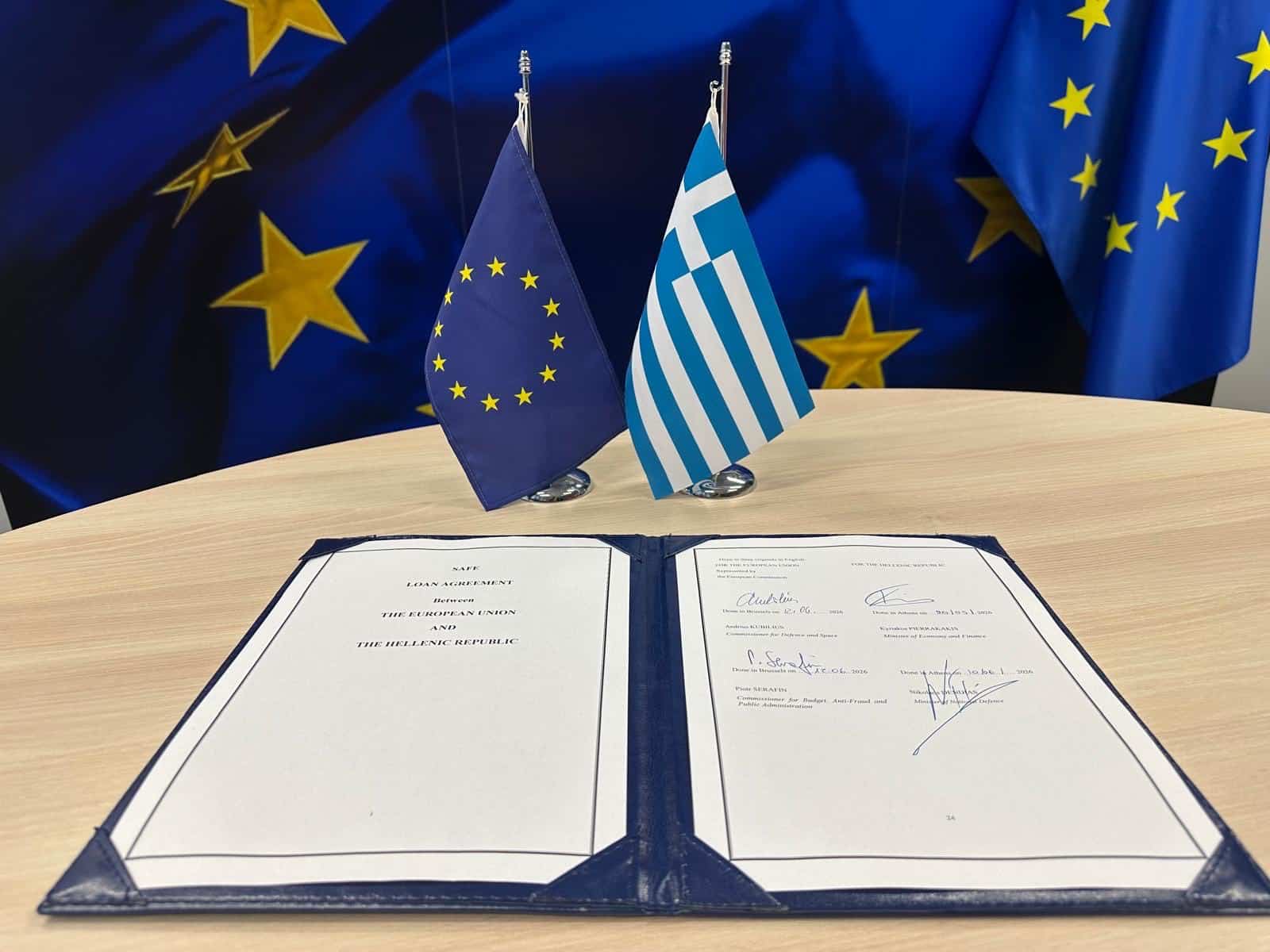
Greece has signed its participation agreement in the EU’s SAFE defense program, giving the country access to up to €787.7 million ($914.7 million) in long-term financing for strategic defense investments.
EU Commissioner for Defense and Space Andrius Kubilius announced the agreement, describing the signing as “another important milestone” for SAFE (short for Security Action for Europe) and European security. According to Kubilius, Greece’s participation will help strengthen the country’s defense capabilities in the Mediterranean, with investments expected in strategic surveillance systems, secure communications, and counter-drone technologies.
Greece gains access to favorable EU defense loans
Under the agreement, Greece can draw up to €787,6 million ($914.7 million) through the SAFE mechanism. The financing is not a direct EU grant but a long-term loan facility offered on favorable terms. The EU’s borrowing capacity and high credit rating will support the loans, allowing participating member states to finance defense projects at competitive costs.
The package also includes €118.15 million ($137 million) in pre-financing, aimed at helping Greece accelerate the launch and implementation of its first approved projects. For Athens, the agreement represents a new route for funding critical defense upgrades without requiring the same immediate fiscal burden that would come with exclusively national financing.
Another strong milestone for #SAFE
and European security — we just signed SAFE agreement with Greece.
It will help
enhance its defence capabilities in the Mediterranean region through investments in strategic surveillance, secure communications & counter-drone technologies. pic.twitter.com/sbx6c2PBYZ
— Andrius Kubilius (@KubiliusA) June 13, 2026
Surveillance, secure communications, and counter-drone systems
Greece can utilize the financing for projects linked to border surveillance, air defense, counter-drone protection, secure military communications, cybersecurity, and other advanced defense technologies covered by SAFE. The focus on surveillance and drone-related capabilities reflects the changing nature of European security planning, as governments move to address threats ranging from unmanned aerial systems to cyberattacks and hybrid operations.
For Greece, the Mediterranean security environment means the program is of great importance. The country’s defense priorities include maritime security, border protection, operational readiness, and the modernization of systems that support deterrence.
SAFE program offers up to €150 billion for European defense
SAFE is one of the EU’s major new defense financing tools. The program provides up to €150 billion ($174 billion) in long-term loans to member states seeking to strengthen their defense capabilities. The mechanism forms part of the EU’s broader effort to reinforce Europe’s defense industrial base, reduce fragmentation in procurement, and speed up joint purchases of military equipment.
By raising funds on financial markets and lending them to participating countries, the EU aims to provide governments with access to large-scale defense financing under attractive repayment conditions. The program also aims to increase Europe’s production capacity and aid the continent in responding to growing security demands more effectively.
Who can participate in the EU SAFE program?
SAFE is open to EU member states, Ukraine, and European Free Trade Association countries that are part of the European Economic Area, namely Norway, Iceland, and Liechtenstein.
As a general rule, investments supported through SAFE must involve joint procurement. A project should include at least one EU member state receiving SAFE financing and one additional EU member state or eligible partner country. However, the program also allows, on a transitional basis, certain national procurement projects to move ahead when they are needed to meet urgent operational requirements.
The two categories of eligible defense projects
SAFE covers defense systems and equipment across two main categories. The first category: includes ammunition and missiles, artillery systems, precision-strike capabilities, land combat systems, soldier equipment, infantry weapons, small NATO Class 1 drones and counter-drone systems, critical infrastructure protection, cybersecurity, military mobility, and counter-mobility assets.
The second category includes air and missile defense systems, surface and underwater naval capabilities, medium and large NATO Class 2 and Class 3 drones, and related counter-drone systems. It also covers strategic enablers such as strategic airlift, air-to-air refueling, C4ISTAR systems, and space infrastructure in addition to the protection of space systems, artificial intelligence, and electronic warfare capabilities.
European content rules for defense contracts
SAFE includes industrial rules designed to ensure that the program strengthens the European defense sector. Procurement contracts must guarantee that more than 65 percent of the value of components and subsystems comes from the EU, EEA-EFTA countries, or Ukraine. Components from third countries cannot exceed 35 percent of the total value.
Projects in the second category face stricter eligibility requirements. Contractors must be able to modify and adapt the systems without restrictions imposed by countries outside the European Union. These conditions support Europe’s strategic autonomy and ensure that critical defense systems can be maintained, upgraded, and adapted without external limitations.
Strategic significance of EU SAFE deal for Greece
Greece’s participation in SAFE places the country within one of the EU’s central defense initiatives at a time when European security priorities are shifting rapidly.
The agreement could help Athens invest in technologies that are increasingly vital for modern defense planning, including drones, electronic warfare, cybersecurity, naval systems, secure communications, and advanced surveillance.
Latest World News



No comments